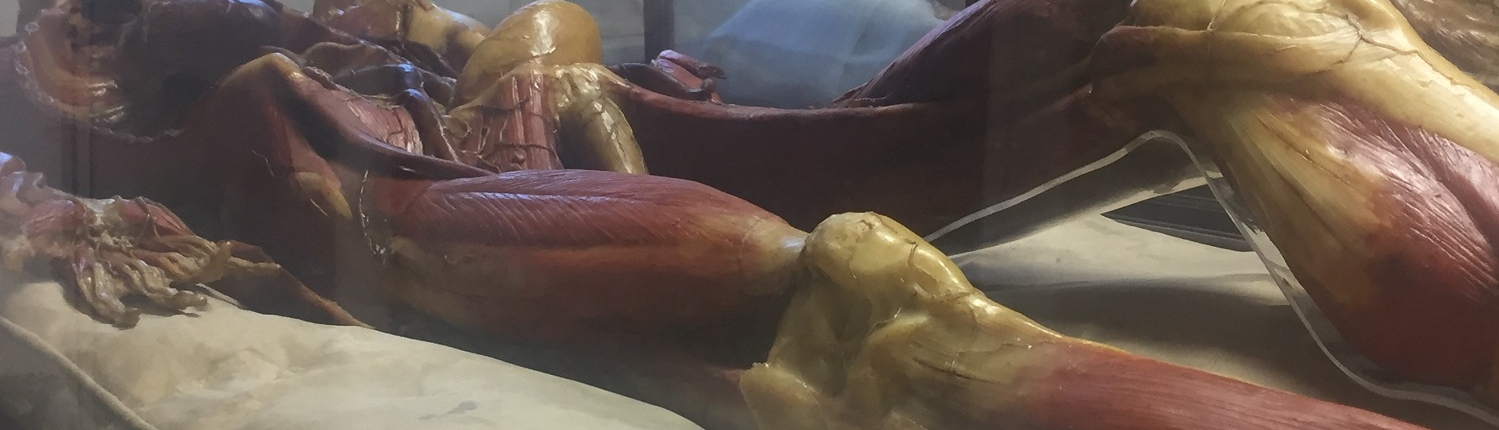
In the waxwork section, two masterpieces attributed to the Florentine School of Clement Susini stand out, possibly the work of a largely unknown waxmaker, Andrea Corsi, anatomical professor of waxmaking in Parma between 1776 and 1820. These are life-size wax statues, with a horizontal arrangement, preserved in glass and wood showcases.
One body shows part of the superficial and deep arterial system in relation to the muscle masses, presenting strong analogies with works by Susini conserved at the Specola in Florence and Vienna.
The other shows the distribution of the subcutaneous lymphatic and venous vascular system, the fine detail of which suggests the contribution, during modelling, of specific anatomical advice such as that which Paolo Mascagni, a great scholar of the human lymphatic system, provided Susini with for many of his works.
Waxwork subcollection
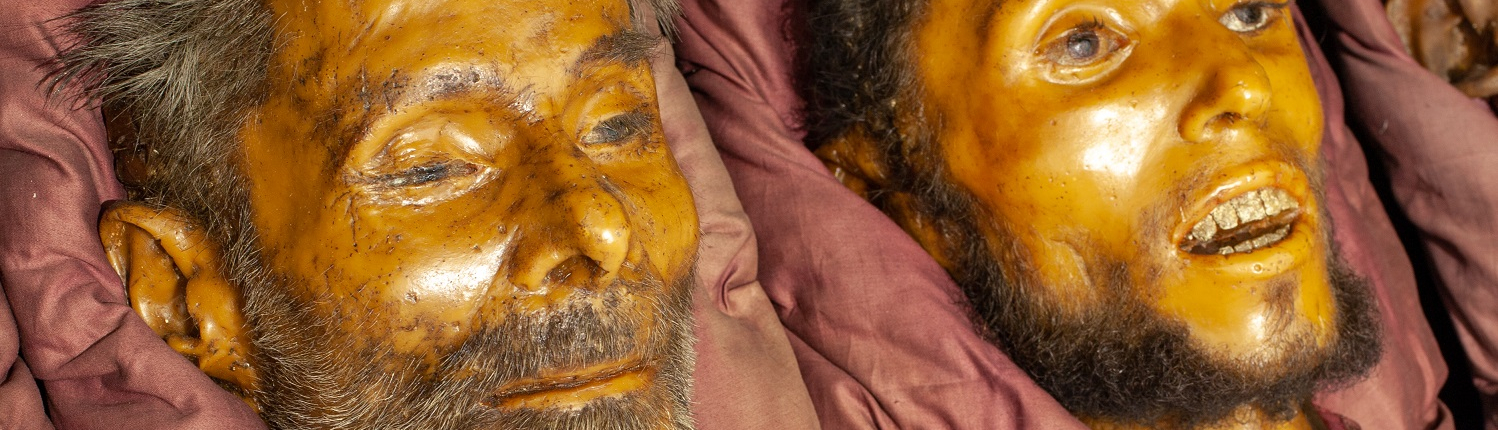
This section is enriched by a collection of 37 wax masks reproducing the faces of criminals, prepared in the late 19th century by the anatomist Lorenzo Tenchini who was a follower of Cesare Lombroso’s physiognomic and criminological theories.
The collection is probably unique in that each mask corresponds to a skull, an encephalon and a section of dry anatomical preparation, as well as a handwritten record of the personal and judicial history of the subject studied.
Some of Tenchini’s masks are now also kept at the Lombroso Museum in Turin, perhaps a gift or unconscious bequest by Tenchini, after his death, to the great forensic psychiatrist from Turin .

