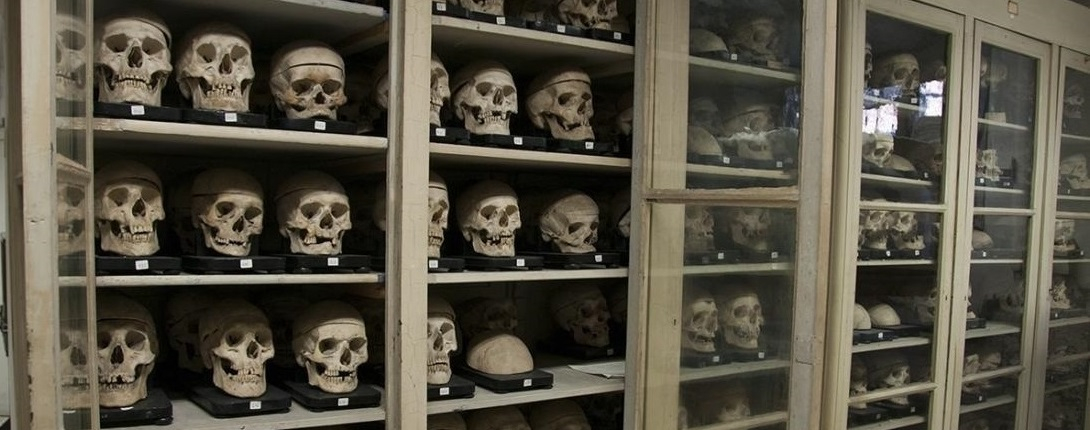
The identification of the real structure and consistency of this extraordinary collection is very recent and constantly expanding.
Until very recently, it was believed that the Tenchini Collection consisted only of a collection of more than 400 human skulls of an anthropological criminological nature – hebephrenics, psychotics, criminally socially dangerous individuals – collected by the Brescian Lorenzo Tenchini (1852-1906) who at the age of 29 in 1881 became Professor of Anatomy in Parma, where he began to study the morphology of the criminal mind in the wake of the phrenological concepts of Franz Joseph Gall (1758-1828) and Johann Caspar Spurzheim (1776-1832).
However, recent research has revealed that these skulls correspond to a collection of mummified encephalises (currently not yet visible to the public) and at least some dehydrated macroscopic preparations, so called ‘dry’.
SKULLS SUBCOLLECTION