
MUST, Italy’s first Museum of Natural Historiography, opens its doors
The MUST, the Museum of Natural Historiography of the University of Parma (Via Università, 12), has been inaugurated. Modern, immersive, sensory and inclusive: strongly desired by the University and financed by the PNRR of the Ministry of Culture, the new exhibition is the result of the redevelopment of the University’s Natural Historiography Museum – now housed in a single, fully accessible location – and is unprecedented in Italy, as the entire collection has been expanded and rearranged into a grand naturalistic narrative that, following a timeline, chronologically reveals its scientific, technological, historical and aesthetic development through the lives and collections of its protagonists. It is not a revolution, therefore, but a true evolution, since the exhibition is completely immersed in its historical context and, through evocative displays, shows how the vision of nature and, with it, the concept of exhibition design has changed over the centuries, from the first private collections to the museum as a public institution.
‘What we are proposing with MUST,’ explains Paolo Martelli, Rector of the University of Parma, “is not just a renovated museum but a new one: characterised by a new vision, a new approach, a new organisation of materials and a new underlying spirit. An inclusive, accessible, immersive space, not only for contemplation but also for interaction, not static but dynamic: a living space that aims to be a 360-degree cultural hub and an important point of reference for the city, the region and beyond. We strongly believe in this, not least because this museum is part of the city’s heritage and houses an extremely valuable cultural corpus: with this intervention, we have sought to enhance it to the fullest.
‘Rethinking the Natural History Museum was a fascinating challenge,’ says Davide Persico, Scientific Director of MUST. “The analysis of the collections and the continuous dialogue with the concept of time led us to favour a historiographical approach, capable of highlighting the protagonists who founded and transformed the museum. This vision gave rise to the Museum of Natural Historiography, a unique institution in Italy and abroad. The exhibition recounts the lives of the figures who have marked its history, the transformation of scientific knowledge throughout different eras and the evolution of natural history museums from their origins to the present day. The result is an innovative project that combines memory, research and dissemination, becoming a real feather in the cap for the University and a new cultural and educational destination for the city of Parma.”
The inauguration will take place on Thursday, 30 October. The first stop is in the Aula Magna, with speeches by Rector Paolo Martelli, Delegate for Museum Activities Donato A. Grasso, Scientific Director of MUST Davide Persico, and architect Maria Amarante, who curated the exhibition, followed by a lecture entitled “Uomini da quando? (Humans since when?)” by Guido Barbujani, geneticist and professor at the University of Ferrara. This was followed by the ribbon cutting and the inaugural guided tour.
Here is the programme for the coming days
31st October. This is an “educational day” dedicated to scientific dissemination and discovery at MUST, with a packed schedule of activities designed for students of all levels, but also open to the general public: meetings, conferences and guided tours taking place in the university classrooms and museum exhibition spaces, covering naturalistic, historical and museum-related topics.
1st November. The doors of MUST will open to the public with a day of free admission and guided tours available upon reservation: an opportunity to explore the collections and learn about the history, science and curiosities they contain.
The Museum of Natural Historiography
Contemplation, interaction, immersion and, above all, inclusion. These are the key principles that led to the creation of MUST, a lively space entirely geared towards visitors, capable of evoking the past as the cornerstone for the creation of the museum of the future. The term Naturalistic Historiography – most likely used for the first time – emphasises how, through a journey through time, it is possible to recount the protagonists, their work and their vision of Natural History in different eras. Thus, the intertwining stories of the figures who founded and contributed to the growth of the former Natural History Museum of the University of Parma, from the second half of the 18th century to the present day, and their collections are recontextualised and enhanced by a chronological, historiographical and sensory journey of great impact and modernity, in step with the evolution of knowledge and modern sensibilities. In a unique location at the University’s headquarters (the previous museum was fragmented into two locations), MUST also serves as a new space for scientific, anthropological and other types of research, with a focus on disseminating the principles of biodiversity, environmental protection and cultural exchange, and as a starting point for new intersections between museum collections and debates on sustainability and the role of the scientific community in relation to society.
From a museological point of view, this was made possible by comparing and implementing the different theoretical positions on exhibition design that have emerged in recent years, leading to the isolation and enhancement of three main values at MUST:
- contemplation, guaranteed by the exhibition layout. The collection comprises around 6,000 items on display, many of which were previously inaccessible but have now been restored to their former glory and given new importance and prestige through their enhanced positioning;
- Interaction, based on the presentation of concepts (display of knowledge, scientific approach, performance space, dialogic logic), with the introduction of multimedia elements that create a direct relationship between the visitor and the story being told. In this specific case, these are animated scenes, with the protagonists of the various sections – played by actors in costume – recounting their collections in the first person, but also describing the characteristics of the museum in its own era according to contemporary tastes and sensibilities;
- the immersion, which stems from the exhibition of environmental installations, as is the case with the two spectacular wunderkammern, the salon of Maria Luigia of Habsburg and the studies of Pellegrino Strobel and Angelo Andres, capable of guaranteeing visitors a total aesthetic experience, catapulting them into the atmosphere of the time in a fascinating journey through the centuries.
In terms of accessibility, MUST far surpasses the previous museum, removing physical, cognitive and sensory barriers to allow all types of visitors to enjoy a fully independent visit. This has been made possible by creating a barrier-free access route on both levels of the museum building: on the ground floor, the single entrance, marked by a tactile floor path, benefits from a new ramp and lift adapted to the needs of visitors with motor and sensory disabilities; on the first floor, sensory and cognitive accessibility to the collections is guaranteed by the installation of new display cases at a height suitable for children and visitors in wheelchairs, the introduction of tactile maps and detailed audio guides for the visually impaired, and the use of digital explanatory aids that allow the deaf to enjoy videos in Italian Sign Language (LIS).
The stages of wonder
The extraordinary journey of MUST begins on the ground floor of the main building of the University of Parma and takes place on two levels. The collection is revealed to visitors through seven themed display cases dealing with highly topical naturalistic issues – anthropogenic and climatic extinctions; environmental protection and sustainability; museums and biodiversity; CITES and illegal trade; private collecting; geographical expeditions; evolution – which aim to introduce visitors to the more immersive and structured tour of the upper floor. Also on the ground floor is a palaeontology section, with significant and impressive finds, including a dolphin bearing the marks of predation by a great white shark – the only one of its kind in the world – and the extraordinary, almost complete skeleton of an eight-metre whale, both dating from the Pliocene epoch (2.6-5.3 million years ago), fossils from the Po floods and Pleistocene mammals.
On the upper floor, the promise of a primarily sensory journey through the past, present and future is revealed with incontrovertible clarity to visitors, who immediately enter a huge, spectacular purple wunderkammer, the historical ancestor of every natural history museum, created in classic Renaissance style with objects from the University’s various historical collections. Crocodiles, sea turtles, leopards, giant shells, colourful birds, strange deformed creatures, corals, sponges, skeletons, skulls… everything in this environment – where the exhibition space is maximised to occupy every surface of the room, from the walls inside the cabinets to the barrel ceiling – contributes to creating wonder and curiosity.
Proceeding on the left, the wunderkammer offers a digression – access is not mandatory, due to sensitive content – in favour of Lorenzo Tenchini‘s anatomical-clinical collection of wax models dating back to the late 19th century. Tenchini was a highly skilled physician who produced facial masks of criminals following the physiognomic and criminological theories of Cesare Lombroso, to whom he supplied them. At the end of the hall of wonders are the famous glass ampoules with stems by Father Jean Baptiste Fourcault, dated between 1760 and 1770: a collection of taxidermied animals, placed in bottles with necks too narrow to insert them, whose creation has remained a mystery for almost three centuries. It is the friar himself – the first founder of an ornithological cabinet in Parma commissioned by the Bourbons – who tells visitors his story from an animated painting, as does Maria Luigia of Habsburg in the next room, who expertly and elegantly introduces her delightful “period salon”, a room decorated in shades of blue, like a noble house, populated by the enormous quantity of artefacts that characterised her reign and her prolific acquisition work (1816-1847), of which the Egyptian goat, the narwhal tooth and the Borgo San Donnino meteorite, which fell in Fidenza in 1808, are particularly noteworthy. The largest section of the MUST collection dates back to the Louis period: crossing the threshold at the exit of Maria Luigia’s drawing room, visitors enter the ancient gallery of the Natural History Museum, a vast and dense exhibition of artefacts, including a section dedicated to comparative anatomy, which bears witness to a historical moment already characterised by a precise division of the sciences, but also by a display method that still reflects a strong aesthetic component.
The layout of the exhibition underwent a significant change in 1859, the year Charles Darwin’s On the Origin of Species was published and Professor Pellegrino Strobel arrived in Parma as a lecturer at the University and director of the Natural History Museum. A progressive and visionary figure, Strobel immediately understood Darwin’s evolutionary theories and applied them to the exhibition system of his museum, giving it a completely unexpected modernity. The MUST recounts the stages of this process through the specimens collected and observed by Charles Darwin and Alfred Russel Wallace, the zoological illustrations of Ernst Haeckel and the meticulous installation of Strobel’s own study. Turning right in the gallery, the MUST offers a substantial zoological and ethnographic collection – also created under Strobel – which recounts colonialism and ethnography thanks to collections from the Congo belonging to the soldier Emilio Piola and the magistrate Temistocle Ferrante (first room) and the section dedicated to Vittorio Bottego (second room), with a vast taxidermy collection from Eritrea and a documentary film that contextualises Bottego as a military man in the service of science, rather than the heroic explorer of the African continent historically portrayed by Italian regime propaganda.
Leaving this section, visitors return to the main gallery to view the Alberto Del Prato collection, a sort of flashback to the biodiversity of the province of Parma in the second half of the 19th century, with a rich series of vertebrates from the Parma area, some of which are very curious because they are now extinct. The exhibition then reaches its penultimate stage with a reconstruction of the study of Professor and Director Angelo Andres, who in 1925 was the architect of the last museum revolution before the birth of the MUST. a great expert in biology and marine fauna – whose photographs and coral collection can be admired – it is with him, through the canonical animated picture, that visitors take stock of the itinerary they have just completed.
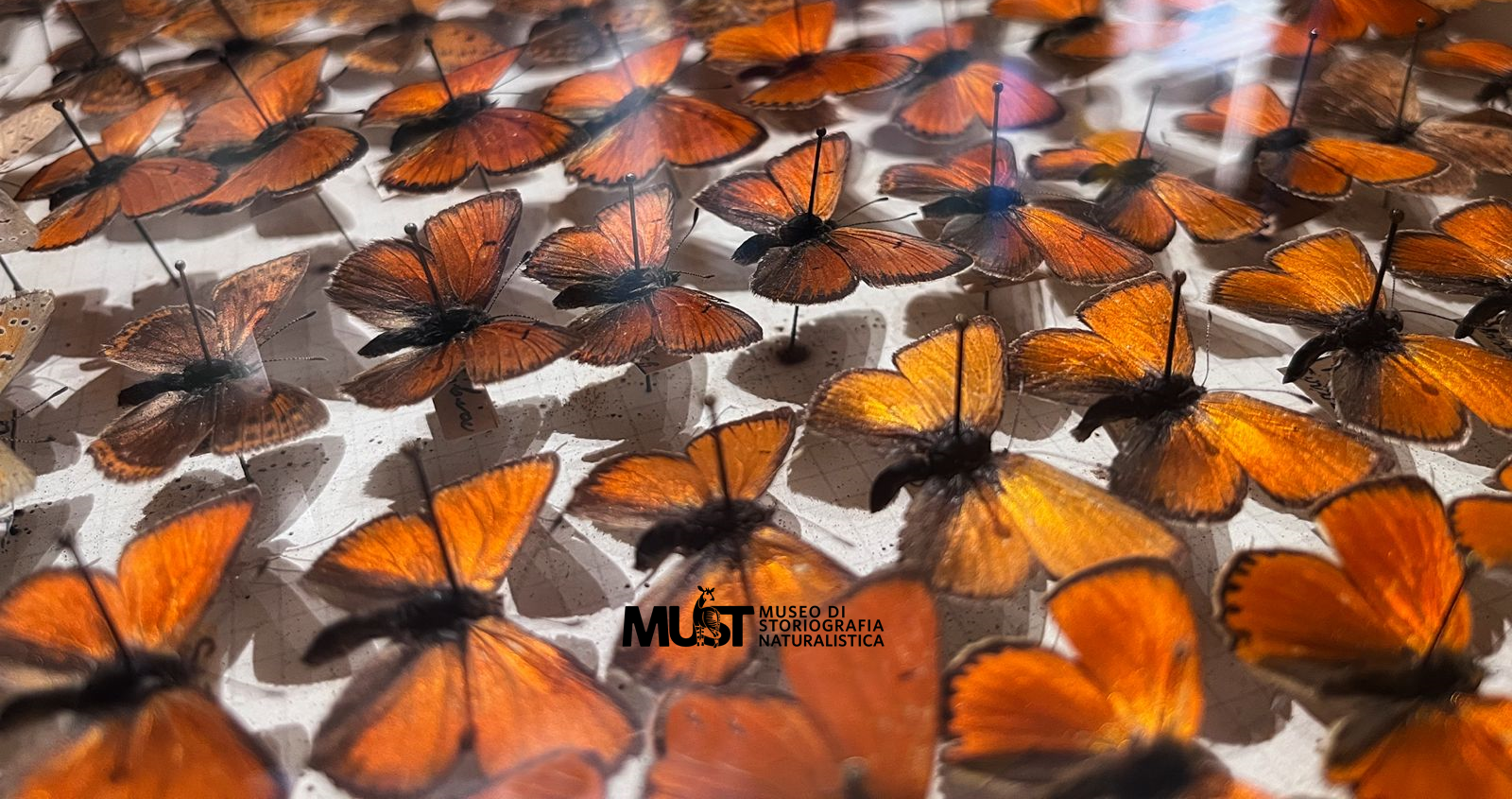
The final act of the journey is a sort of abrupt and dreamlike return to the future, an intelligent circularity. An enormous Kubrickian monolith stands out in front of the visitor, inviting them to enter what is effectively a second wunderkammer, hypermodern and futuristic, where, free of any classification or information, in a riot of colours, there are almost three hundred entomological boxes: this is the collection of local and exotic lepidoptera and beetles created by Don Ezio Boarini and acquired by the Museum in the 1990s, now on display for the first time in all its spectacular entirety.
Related Events