The Museum of Natural History (MSN) is the oldest museum of the University of Parma and is part of the Sistema Museale di Ateneo (SMA).

The collections housed here constitute a scientific and historical heritage of extreme importance for the research and dissemination of scientific culture.

The origins of the current Natural History Museum date back to the Cabinet of Ornithology, established in 1766 by Father J.B. Fourcault (1719-1775), a friar of the Convent of the Minims and ornithologist at the Bourbon court.

In 1768, the Jesuits were expelled from the Duchy and the Palazzo di San Rocco was confiscated from them, which from then on became the seat of the University and the place to which the Cabinet was transferred, which Fourcault directed until his death in 1775.

He was succeeded by Michele Girardi, under whose direction the Cabinet first took the name Gabinetto degli Animali and then the definitive name Museo di Storia Naturale (1780). There followed a period of abandonment of the Museum under French rule following the transformation of the University into an Academy.

The provisional government, following Napoleon’s abdication, re-established the University in 1814 and the Museum resumed its activities.

It was then divided into two sections: the zoological section headed by Giovanni Cotti and the mineralogical section entrusted to Mario Bagatta. Cotti was succeeded by Marziale Caggiati and Bagatta by Andrea Piroli.
A real revival of the museum was due to the Duchess of Parma Maria Luigia of Habsburg (1791/1847) and her interest in the Naturalia: the collections increased significantly, especially under the direction of Giuseppe Monici (1812-1859), with the acquisitions of zoological collections, including those of Entomology (Eugenio Bertè) and Ornithology (Del Sette), which were added to the geological and mineralogical collections already present.

In 1849, the University was abolished again, this time by Duke Charles III, and the Museum was moved, with irreparable damage to the collections, to the Ducal Garden Palace. It was then permanently moved back to the Palazzo San Rocco in 1856.

Three years later (1859), the distinguished naturalist Pellegrino Strobel, one of the first Italian zoologists to follow the evolutionary theory and initiator, with his pupil Luigi Pigorini, of Palethnology, was called to direct the museum.

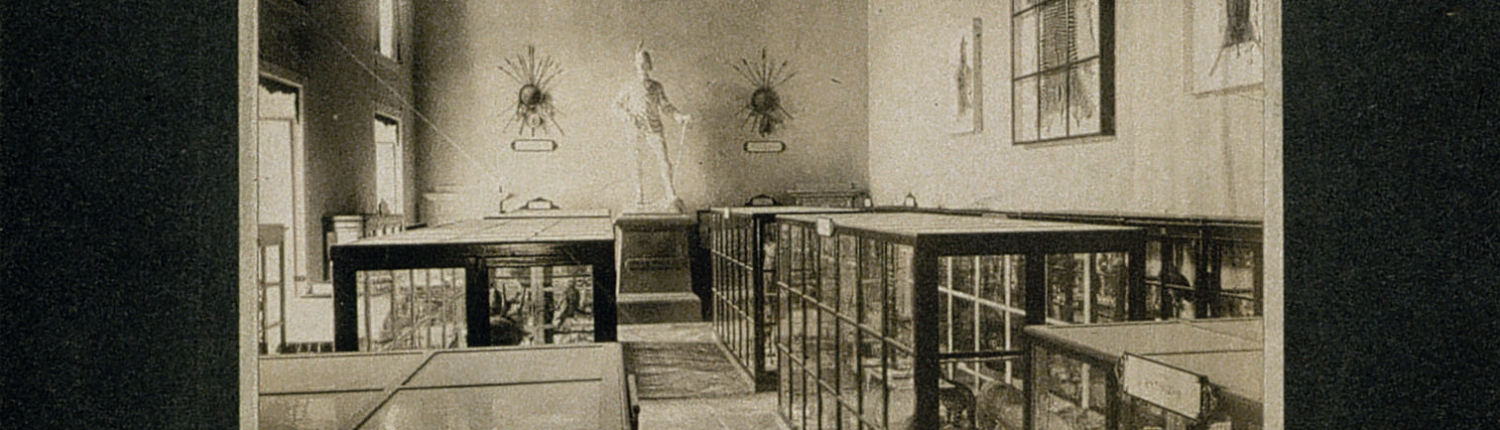
Under Strobel, the museum took on an important cultural role: he carried out extensive explorations in nature, including the Argentine Andes, and was a keen scholar of the Apennine malacofauna. Under Strobel’s direction, the museum, located on the first floor of San Rocco, consisted of several exhibition rooms: one dedicated to zoology, one to palaeontology and palethnology, two to mineralogical collections, as well as two rooms with geological and mineralogical collections. Office, laboratory and storage rooms were attached to the museum.

Strobel was also responsible for the first exhibition of material collected in Eritrea by the Parma explorer Vittorio Bottego.
The Bottego Collection was opened to the public in 1891 and, for reasons of space, was placed in the nearby Palazzetto San Rocchino.
Three halls and two rooms, located on the ground floor, housed the Eritrean zoological material displayed in an evolutionary manner. As Strobel rightly noted, this was the first exhibition of regional fauna

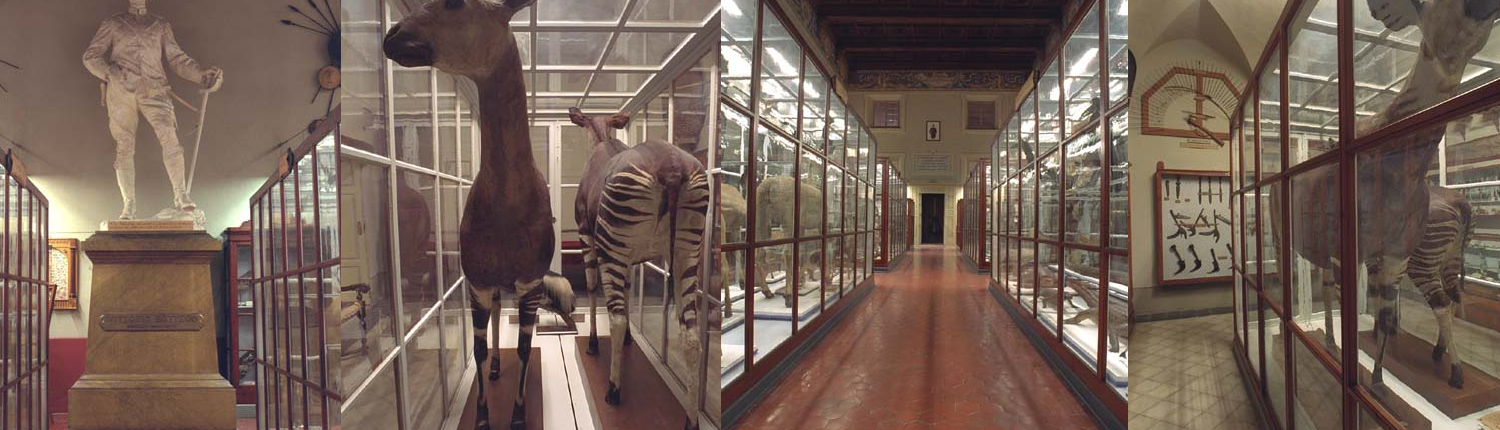
The current configuration of the museum in the university building is owed to Angelo Andres (1851-1934), who succeeded Strobel and who, during his long tenure, succeeded the Vittorio Bottego Eritrean Museum in 1907, located in the splendid hall on the first floor of the university building, the adjoining Piola Hall, containing a small Congolese zoo-ethnographic collection (1907), and in the years 1923-25 the Gallery of Vertebrate Animals (or Systematics), with an adjoining Skeleton Hall (commonly referred to as the Hall of Comparative Anatomy). Andres was succeeded in the direction of the museum, which was then attached to the Institute of Zoology whose director was also the museum’s director, by several zoologists including Antonio Pensa, Antonio Venceslao Porta, Francesco Lanzoni, Antonio Balli, Claudio Barigozzi, Lodovico Di Caporiacco and Bruno Schreiber.

The abolition of the Faculty of Science (1924) certainly did not benefit the museum; the lack of interest in museum research that characterised the subsequent period led to a period of stagnation for the museum, which remained crystallised until 1980, also suffering erosion of space. In that year, thanks to the interest of the then Rector Giuseppe Pelosio, administrative autonomy was given to the museum, which took its current name of Natural History Museum, allowing, thanks above all to the work of director Vittorio Parisi, a relaunch of the museum, also in relation to the acquisition of the premises in Via Farini 90.

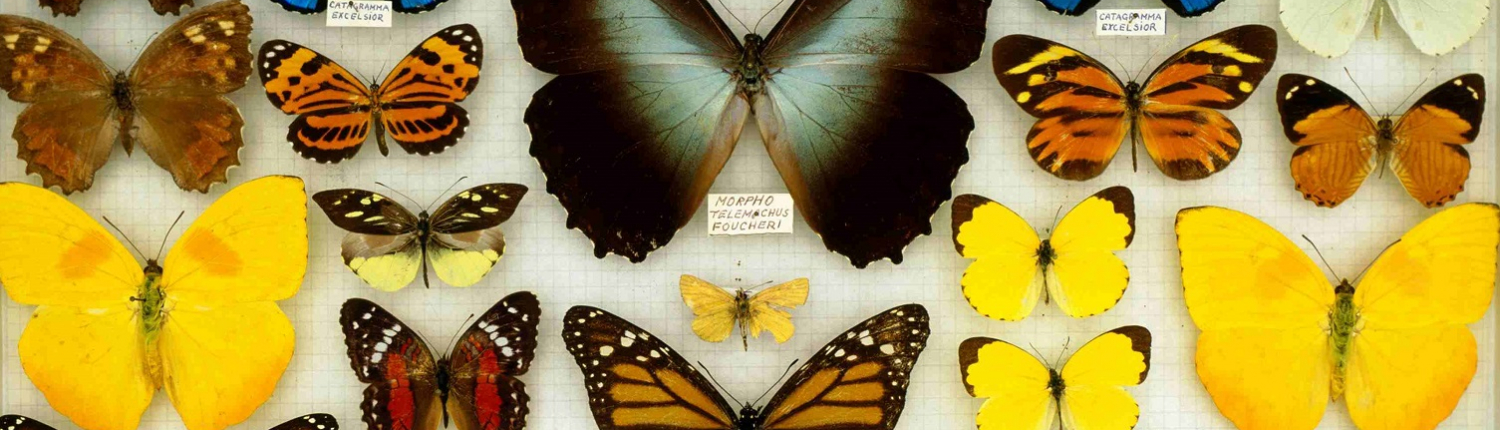
In 1980, the museum acquired modern premises at the Botanical Garden, where an educational section was created, with rooms open to the public dedicated to the fauna of the Parma area (Del Prato collection), Lepidoptera (Don Boarini collection), biological evolution and the history of the territory (Strobel rooms). The Annibale Tornielli Ornithological Library and the Temistocle Ferrante Room, which houses a Congolese ethnographic collection from the early 20th century, are located here.
Prof. Maria Grazia Mezzadri, who succeeded her in the direction of the Museum, continued the important work of researching and enhancing the collections, organising numerous scientific exhibitions and editing the catalogues.
Currently, first under the direction of Prof. Davide Csermely and later under that of Prof. Cristina Menta, the systematic restoration of specimens and the cataloguing of all museum exhibits is underway.
Finally, the museum plays an important role in museum education for schools of all levels, by offering guided tours and interactive workshops.

© Copyright - Sistema Museale di Ateneo