

MUST: all the charm of restoring wax sculptures
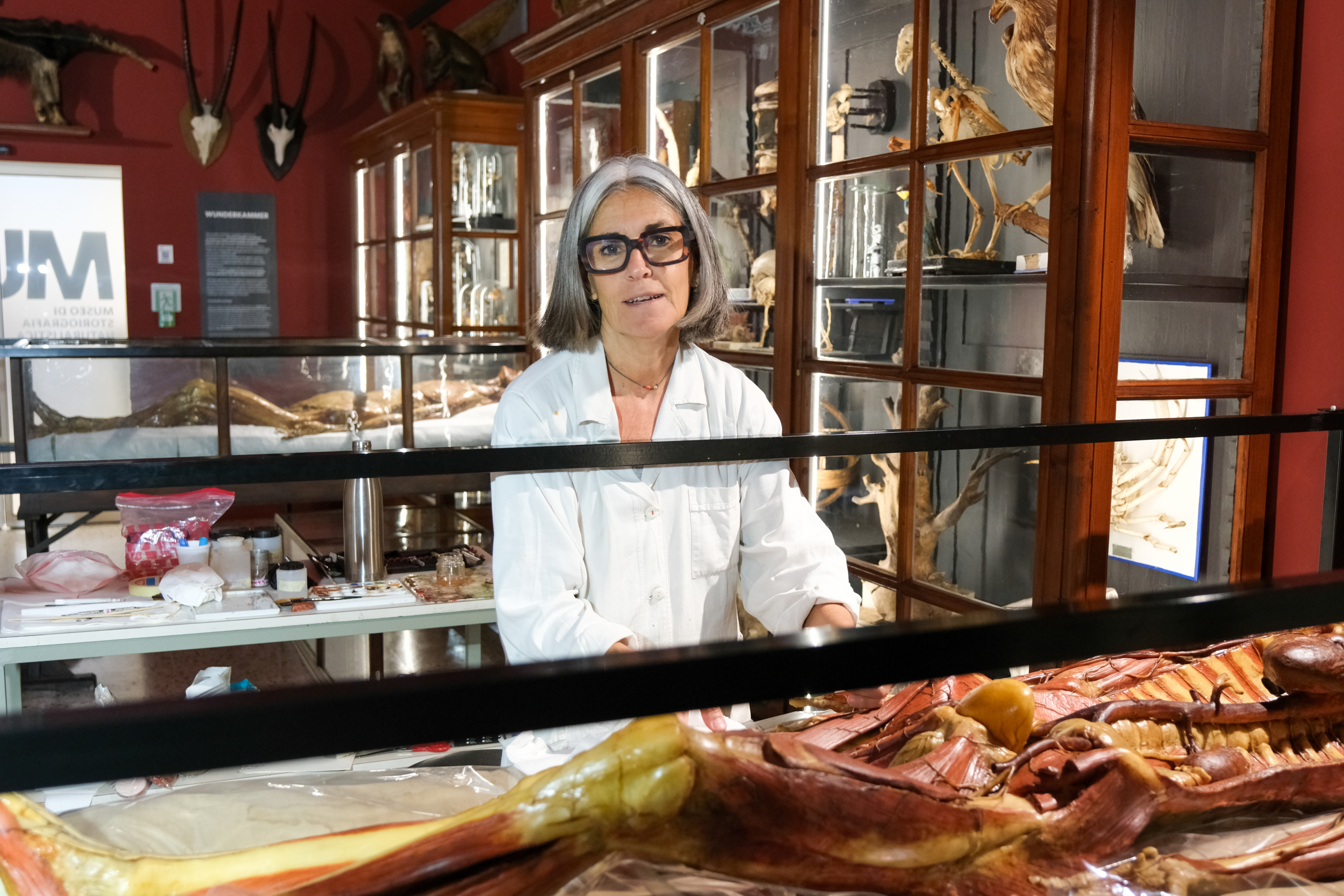
Maria Grazia Cordua working on an 18th-century anatomical statue in the museum’s Wunderkammer.
Watching her at work is fascinating, to say the least. Listening to her talk about her work – and the passion she puts into it – is, if possible, even more so. The restorer Maria Grazia Cordua is currently at the University’s Museum of Natural History – MUST: she is working on an 18th-century anatomical wax statue (attributed to Andrea Corsi, School of Clemente Susini; ‘Lorenzo Tenchini’ Biomedicine Collection) which, together with another, is displayed in the Wunderkammer, the first room visitors encounter on their tour of the museum.
She is from Florence (she trained at the Opificio delle Pietre Dure) and is one of the few people specialising in this type of restoration. She has previously worked for the University of Parma, specifically for the Botanical Garden, on the restoration of several specimens from the precious collection of wax fungi donated by Maria Luigia of Austria to the University in 1819 – a masterpiece of wax modelling of the highest artistic and scientific value.
Visitors to the MUST at the moment will find her at work in the first room. “This work was already restored in Florence in 2012 and is therefore in good condition,” she explains, “but since then it has been moved a few times and, until recently, was kept in a different environment to its current one, so some minor damage had occurred. Two muscle bands had come away, a few small cracks had appeared, and so on.”
How do you go about restoring these pieces? “The first stage,” he explains, “is cleaning. Then comes consolidation: resin is injected into the cracks using a syringe, and then the gaps are filled and repairs made using wax, which is very different from the original beeswax. The new waxes deteriorate much less and are far more elastic.’ The tools used are also different, allowing for highly precise work with the wax applied at the correct temperature. The little ‘wax heater’ used years ago is now just a memory. ‘The final step is the finishing touches, which are applied with a brush.’
Her words highlight the importance of research into materials, which, she emphasises, ‘stems from study, from the work itself, and from discussions with colleagues’. Which restoration project is closest to her heart? ‘The botanical wax models at the Museo della Specola in Florence. It’s the collection I’ve been most passionate about,’ concludes Maria Grazia Cordua, ‘not least because, on and off, I’ve worked on it for more than twenty years.’


